
WØRKS On Hand: Arkhé
How Jake Kellie built a Michelin-starred kitchen without a single gas burner In a heritage building on The Parade.
You could walk past 127 The Parade and not look twice. The white frontage is neat, a little prim even, and the building looks narrow from the street. It’s a decoy.
Step inside and the light drops. The first room you reach is a lounge, the darkest space in the building, and that’s entirely deliberate. Somewhere beyond it you’ll catch the smell of ironwood burning down to coals, and you’ll understand the name before anyone explains it.

Photo: Timothy Kaye, courtesy of Studio Gram
The name
Arkhé (pronounced ar-kay) comes from ancient Greek. Kellie describes it as the beginning of all the elements, the beginning of fire. It’s a big word for a neighbourhood restaurant in Norwood, and it turns out to be exactly the right size.
The chef
Jake Kellie decided to become a chef for the most honest reason there is: he loved eating. He took food technology at school, won a local award, started an apprenticeship and never really looked up again.
The CV that followed is the kind that makes other chefs go quiet. Australian Young Chef of the Year in 2015. Time in the kitchens of Maze, The Fat Duck and The Ledbury. Winner of the S.Pellegrino Young Chef award for South East Asia, then second in the world at the 2018 final in Milan with an aged pigeon dish. And then Burnt Ends in Singapore, the wood-fired barbecue restaurant where he rose to head chef and which picked up its first Michelin star under his leadership, alongside a place on the World’s 50 Best list.
He moved to Adelaide in 2019. There was a stint at Leigh Street Wine Room, where he had elevation grills installed, and a run of charcoal pop-ups at Pirate Life in Port Adelaide. Then he and Martin Palmer of Palmer Hospitality (the group behind 2KW, Fishbank and Paloma) bought the old Stone’s Throw building on The Parade outright, and Kellie got the thing chefs almost never get: the freedom to build the exact restaurant in his head. Arkhé opened at the end of 2021.
These days he’s also Culinary Director at Kingsford The Barossa, whose restaurant Orleana made the Michelin Selected list too. Arkhé is still home base.
The fire

Photo: Timothy Kaye, courtesy of Studio Gram
The centre of gravity is a three-and-a-half-tonne wood-burning oven. Ironwood, which burns very hot, makes the coals for four elevation grills and an open hearth. There’s no gas and no electricity in the cooking. None.
Kellie doesn’t cook a particular cuisine so much as a particular method. Seafood features heavily, as does the restaurant’s ferment wall, stacked with house-made garums and misos. Produce comes from South Australian growers like Mayura Station, Ngeringa and Biopark. The dry-aged wagyu T-bone has a following of its own; it helped Arkhé land 16th in the world (and 5th in Australia) on the World’s 101 Best Steak Restaurants list.
When Michelin’s inspectors wrote it up, they mentioned Peking duck wontons with smoked duck broth and Eyrewoolf abalone, and they pointed diners towards the counter. Take the hint. The eighteen counter seats ringing the kitchen are the best in the house, close enough to feel the heat on your face.

Photo: Timothy Kaye, courtesy of Studio Gram
Kellie also uses the kitchen as a meeting place. His arkhé & friends series invited twelve chefs over twelve months to cook at The Parade, including Jordy Navarra of Manila’s Toyo Eatery and Melbourne’s Rosheen Kaul.
The room
Studio Gram, the Adelaide practice founded by Dave Bickmore and Graham Charbonneau, was given a brief that sounds simple and isn’t: make something the city hasn’t seen before.
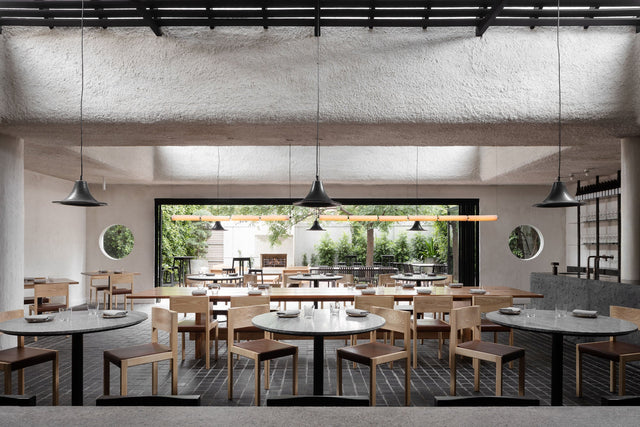
Their answer was to take Kellie’s fire literally. The interior is about time and decay, the things heat and use do to materials. The palette is warm whites and smoky blacks. Imperfection is the point: frayed fabrics, worn ceramics, knots in the timber, wrinkles in the linen. Weathered timber sleepers appear throughout. The whole place is meant to look as if it has always been there.
The building didn’t make it easy. There’s a 400mm level change between the front door and the back courtyard, and a long, dark, corridor-like middle section that most designers would quietly write off. Studio Gram used both to break the venue into three distinct rooms: the moody lounge, the dining room and the courtyard. Time Out’s tip is to sit at the very back, against the leafy courtyard, where you feel outside and inside at once. We agree.

Photo: Timothy Kaye, courtesy of Studio Gram
The details reward a second look. The chef’s table is a sculptural piece by Studio Gram, ringed by eight Thea chairs from local maker Remington Matters, with a curtain and art installation on one side and Kellie’s own collection of fermentation jars on the other (all of them in active use). Above the communal table, which seats eighteen, hangs a four-metre run of slip-cast porcelain tubes made by Adelaide studio Handmade & Found. The design extends into the branding, the menus and the uniforms.
The industry noticed. Arkhé won the Hospitality Design Award at the 2022 Australian Interior Design Awards, plus Best of State for Commercial Design in South Australia, and was commended for Best Restaurant Design at the 2022 Eat Drink Design Awards. The AIDA jury chose it unanimously, praising a single strong concept carried all the way through without a hint of gimmick.
The basin
A room that celebrates worn ceramics and creased linen is never going to put a plastic pump bottle by the tap. It needs something that belongs in the same story: minimalistic glass, honest ingredients, nothing pretending to be anything else.
Which is how our Bergamot Wash and Balm ended up there. After an evening of woodsmoke and charred everything, bergamot peel, neroli and cedarwood is a clean, bright break. The Wash is a true liquid soap made from organic olive and coconut oils. It lathers slowly, cleans without stripping and leaves hands feeling bright, not tight. The Balm follows and is gone in under a minute.
Arkhé · 127 The Parade, Norwood SA 5067 · arkhe.com.au
More from this series: Australia’s first Michelin stars · Anvers · Fugazzi
Header photo: Timothy Kaye, courtesy of Studio Gram
0 Comments
There are no comments for this article. Be the first one to leave a message!