
Australia’s First Michelin Stars, and the Basin Down the Hall
Michelin finally came to Australia, and it started in SA. Three of the restaurants it singled out have something in common, and it isn’t on the menu.
On the evening of Wednesday 14 October, a ballroom full of chefs at the Adelaide Convention Centre went very quiet. The Michelin Guide had been published for more than a century, and in all that time it had never rated a single restaurant in Australia. Someone on stage was about to read out the first name.
It was Anvers. Connor Bishop walked down the aisle to collect the star, and the room erupted.
By the end of the night, eleven South Australian restaurants held stars. Others were named Michelin Selected. If you’re wondering why a Melbourne scent company cares this much about a restaurant guide in Adelaide: three of those restaurants chose our Bergamot Wash and Balm for their guest amenities.
What Michelin actually judges
It's worth being honest about this up front. Michelin doesn’t inspect the bathroom. Its inspectors are anonymous, they visit more than once, and they judge the plate and only the plate: the quality of the ingredients, the technique, the chef’s personality coming through in the cooking, the harmony of flavours and whether all of it holds up from one visit to the next. Decor and service don’t come into it.
But here’s what we’ve noticed, having spent time in all three. The kind of place that cooks well enough to catch an anonymous inspector’s attention is usually the kind of place where nothing is left to chance. Somebody chose the chairs. Somebody chose the glass your water comes in. And at some point, somebody stood in the bathroom and thought hard about what sits next to the tap.
That’s the moment we get chosen. It’s the one we’re proudest of.
Arkhé, Norwood · One Michelin Star

Photo: Timothy Kaye, courtesy of Studio Gram
Behind a neat white heritage frontage on The Parade, Jake Kellie cooks everything over fire. Not mostly. Everything. There’s no gas and no electricity in the cooking, just a three-and-a-half-tonne wood-burning oven and ironwood coals feeding the grills and an open hearth.
Kellie came to Adelaide from Singapore, where he was head chef at Burnt Ends, the barbecue restaurant that won its first Michelin star on his watch. Arkhé opened in late 2021 with business partner Martin Palmer, and the inspectors singled out his Peking duck wontons in smoked duck broth and the Eyrewoolf abalone.
The room was designed by Adelaide’s Studio Gram and won the Hospitality Design Award at the 2022 Australian Interior Design Awards. It’s built around imperfection on purpose: worn ceramics, frayed fabric, knots left in the timber.
Read more: Arkhé, cooking with nothing but fire →
Anvers, Kangarilla · One Michelin Star

Photo: David Sievers, courtesy of Stallard Meek Flightpath Architects
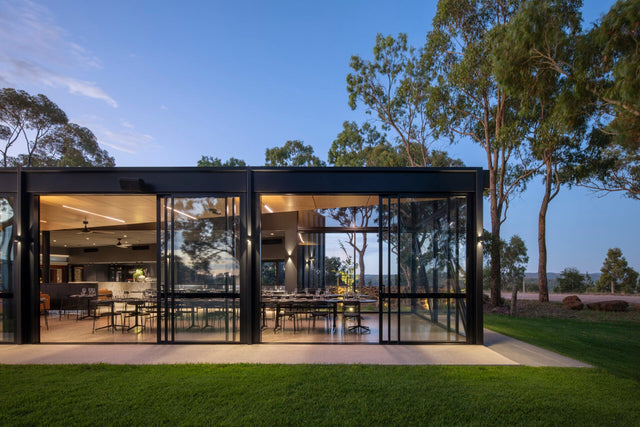
Up Razorback Road, on a family vineyard at the southern edge of the Adelaide Hills, a 1949 dairy has become a cellar door, and a glass-walled dining room has been built onto it. Wayne and Myriam Keoghan met in Belgium in 1983 and named the estate after Myriam’s hometown, Antwerp, which the French call Anvers.
The kitchen belongs to Connor Bishop, a Cornish-born chef who has cooked on the Fleurieu for over a decade. His Long Story menu, built around the likes of Paroo kangaroo, Murray cod and damper, was the first name read out on Michelin’s Australian stage. The inspectors also noted that the view alone justifies the drive. They’re right.
Read more: Anvers, the first name called →
Fugazzi, Adelaide · Michelin Selected

Photo: Jonathan VDK, courtesy of Studio Gram
On a laneway off Leigh Street, in the old Rigoni’s site, Laura and Max Sharrad run an Italian-American dining room that borrows its name from New York slang for a fake. Nothing else about it is.
The inspectors picked out the tagliarini with hand-picked blue swimmer crab, the gnocco fritto, and the tiramisu finished at the table. Michelin Selected isn’t a star, but it’s a place in the guide’s main selection that only fifty restaurants in the state can claim. Studio Gram designed this room too, in the opposite direction to Arkhé: velvet, marble, leather and a deliberate sense of déjà vu.
Read more: Fugazzi, nothing fake about it →
The thread
Put the three side by side and they don’t look like they should share anything. A fire-led counter in a sandstone building. A long lunch in a winery above the vines. A maximalist Italian room in the middle of the CBD.
What they share is a state of mind. Every one of them was built by people with strong opinions about small things: the weight of the cutlery, the temperature of a room, the moments between courses when a guest gets up from the table. Nobody here does anything by default. Michelin’s own director said fire was the thread through South Australia’s selection. We’d add a second one.
Same bottle, either way

There’s no restaurant edition of our products. The Bergamot Wash and Balm by the basin at Arkhé and Anvers is exactly what comes out of our Melbourne filling room and onto your doorstep: same formula, same 500ml glass bottle.
Bergamot is bright and crisp, like freshly cut citrus, grounded by neroli flower and cedarwood. The Wash is a true liquid soap, saponified from 98% certified organic olive and coconut oils, with no sulphates and no synthetic detergents. The Balm follows with five plant oils (sweet almond, macadamia, soybean, shea and cocoa seed butter) that absorb in under sixty seconds.
The only real difference between their basin and yours is the bill.
Photography courtesy of Studio Gram (Arkhé: Timothy Kaye; Fugazzi: Jonathan VDK) and Stallard Meek Flightpath Architects (Anvers: David Sievers).
0 Comments
There are no comments for this article. Be the first one to leave a message!