
Anvers: The First Name Called
How a Belgian love story, a 1949 dairy and a chef from Cornwall ended up with the first Michelin star ever announced in Australia.
Razorback Road doesn’t hurry. It climbs out of the southern edge of the Adelaide Hills, past paddocks and vines, up to a north-facing block at 383 metres where the hills start to lean towards McLaren Vale. In the late afternoon a breeze comes in off the south-east and the temperature drops a few degrees. The grapes like it. So do the people having lunch.
This is Anvers. On 14 October it became the first restaurant in Australia ever to be called up for a Michelin star.
Belgium, 1983
The story starts on the other side of the world. Wayne and Myriam Keoghan met in Belgium in 1983. When they planted their own vineyard at Kangarilla in 1998, they named it after Myriam’s hometown, Antwerp, using its French name: Anvers.
The estate is Adelaide Hills to its bones. Sixteen hectares are planted to shiraz, chardonnay, sauvignon blanc, gamay and barbera, among others, on soils of buckshot ironstone, quartz and clay. Kym Milne MW, a Master of Wine who was once chief winemaker at New Zealand’s Villa Maria, makes the wines alongside Matthew Keoghan. The vineyard has been certified with Sustainable Winegrowing Australia since 2023.
Wayne’s philosophy fits on a postcard: “Why bother making a wine that is less than excellent?”
The Belgian thread never went away, either. Since 2023, Anvers wines have been poured at Tomorrowland, the enormous Belgian music festival, under a range called Acta Non Verba. Actions, not words. It suits them.
The dairy and the glass room

Photo: David Sievers, courtesy of Stallard Meek Flightpath Architects
The cellar door is the estate’s oldest building: a dairy built in 1949 that once served the local Kangarilla community. It’s been lovingly updated, and these days it opens straight into something completely new.
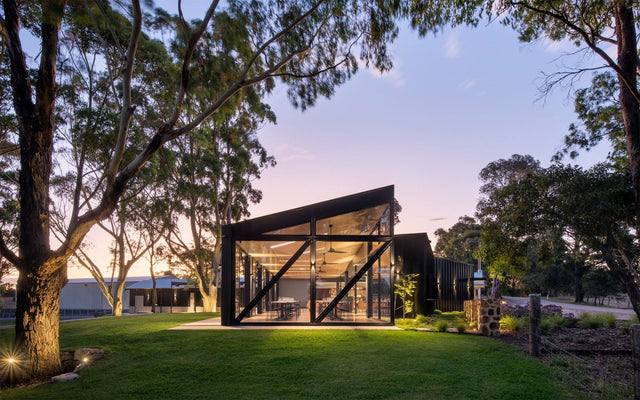
That new building is the restaurant and function space, designed by Stallard Meek Flightpath Architects. Project architect Jacqui Stacey led it, an architect early in her career, with mentoring from director Scott Meek. The brief was to honour the dairy rather than overshadow it. The result rests lightly on the land, uses a material palette that sits comfortably next to the original building, and gives almost every seat a panoramic view through walls of glass.

Photo: David Sievers, courtesy of Stallard Meek Flightpath Architects
The project took home an EmAGN Project Award from the Australian Institute of Architects, recognising a building led by an emerging architect. The jury singled out its careful handling of scale. You notice that on arrival: it’s a serious restaurant that still feels like a family place.
The chef
Connor Bishop grew up in Cornwall and moved to Australia in 2006. He’s lived on the Fleurieu Peninsula ever since and has been in kitchens since the age of fourteen.
He was named TAFE SA Apprentice Chef of the Year in 2019 and spent time as pastry chef at Maxwell in McLaren Vale (which, as it happens, also picked up its first star this month). He then took over The Kitchen at Bec Hardy, earning two hats from the Australian Good Food Guide with scores of 14 and 15. At Anvers he went further, debuting with a score of 17 in the 2026 Australian Good Food Guide Chef Hat Awards.
Bishop talks about his cooking in terms of precision, restraint and place. He has said the Adelaide Hills makes you cook seasonally and honestly, because the region won’t let you do otherwise. He’s also clear that running a kitchen is less about being the best chef in the room and more about the people, the systems and the young cooks learning on the line.
The Long Story

Photo: David Sievers, courtesy of Stallard Meek Flightpath Architects
The menu is called the Long Story, and it reads like a love letter to the country it’s cooked in. Michelin’s inspectors named Paroo kangaroo, Murray cod and damper bread as highlights, calling the cooking simple in the very best way, finished with Anvers’ own wines.
They also said the views alone were worth the trip. Lunch is the only sitting, which means you get the full arc of a Hills afternoon: bright at noon, gold by four, the vines going long-shadowed outside the glass while someone tops up your chardonnay.

Photo: David Sievers, courtesy of Stallard Meek Flightpath Architects
The basin
When you drive an hour for lunch, you notice everything. The weight of the glassware. The linen. The quiet walk to the bathroom between the main and dessert, when the dining room noise falls away and you catch your reflection against the hills.
That’s where you’ll find our Bergamot Wash and Balm. Bergamot suits this place more than we could have planned. It’s crisp citrus over neroli and warm cedarwood, a golden-hour scent for a golden-hour restaurant. The Wash is a true liquid soap from organic olive and coconut oils that cleans without stripping. The Balm’s five plant oils sink in before you’re back at the table.
Same bottle you can have at home. Fewer hills, admittedly.
Anvers Restaurant & Cellar Door · 633 Razorback Road, Kangarilla SA 5157 · anvers.com.au
More from this series: Australia’s first Michelin stars · Arkhé · Fugazzi
Header photo: David Sievers, courtesy of Stallard Meek Flightpath Architects
0 Comments
There are no comments for this article. Be the first one to leave a message!