
What's the difference between hand soap and hand wash?
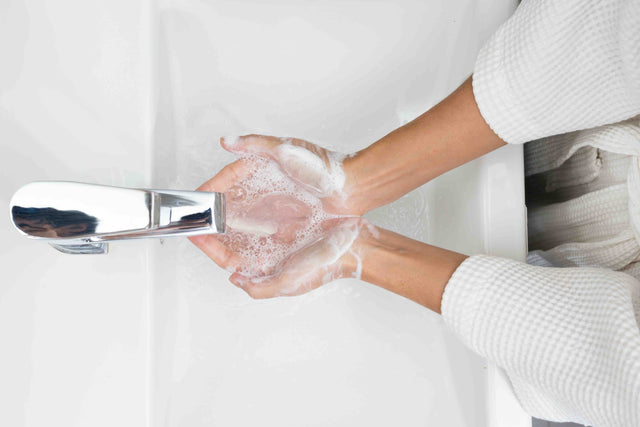
The short answer: most products sold as “hand wash” are not soap at all. They are synthetic detergents, built on the same surfactant bases used in dishwashing and laundry liquid. True liquid soap is made by saponifying natural oils with an alkali, and it is non-toxic, biodegradable and naturally moisturising.
We’re washing our hands more than ever, but what are we washing them with? Here is what actually separates true liquid soap from a detergent-based hand wash, and why it matters for your skin and for what goes down the drain.

What is true liquid soap?
Liquid soap is the product of a natural reaction between fat, alkaline and water. It came about around 5,000 years ago as a by-product of ash (alkaline) combining with animal or plant oils (fat) and water. Ancient civilisations quickly realised that this foamy lather could be used for cleaning their skin along with washing wool and cotton for textile manufacture.
While the process of soap making has been refined over many years, the principles remain the same: natural oils are saponified, or mixed, with an alkaline solution such as lye (sodium hydroxide) to create bar soap, or potash (potassium hydroxide) to create liquid soap. The result is a 100% natural formulation that effectively cleans skin and breaks down bacteria.
Soap is naturally non-toxic, biodegradable and made with 100% natural raw materials. Liquid soap contains naturally-occurring glycerine, which is highly moisturising and leaves skin smooth and soft without the need for synthetic emollients or added moisturisers.
Every WØRKS Hand & Body Wash is made this way, from 98% certified organic olive and coconut oils, in small batches in Melbourne.
Is soap actually better at cleaning than antibacterial hand wash?
The natural origin of soap shouldn’t be confused with feel-good factor. Many scientific studies prove the efficacy of soap, including a 2007 study by Harvard Health which found that the unique molecular structure of liquid soap outperforms modern antibacterial hand wash while also protecting the skin’s microbiome.
A hand hygiene study conducted by Rutgers University, New Jersey found that water temperature plays no part in eliminating bacteria and other pathogens. The determining factor in hygiene was the use of soap. The same study found that antibacterial hand wash did not perform any better than liquid soap in removing bacteria from the skin. A 2015 study in the Journal of Antimicrobial Chemotherapy reported the same findings.
What is a detergent-based hand wash made of?
Many hand washes are made with a basic detergent base, the same sort that you find under your kitchen sink. Most (even those marketed as natural) are formulated with synthetic surfactants, or foaming bases, like SLS (sodium lauryl sulfate), SDS (sodium dodecyl sulfate), ALS (ammonium lauryl sulfate) or SLES (sodium lauryl ether sulfate).
These surfactants are derived from petroleum or made synthetically. Either way, they are heavily processed. These surfactant detergents can be used as a base for hand wash, body wash, dishwashing detergent, laundry detergent and car cleaning detergent.
The consumer trend away from SLS has seen it substituted for glucosides, which are foaming agents that are claimed to be ‘naturally derived’ but are heavily processed and synthesised in laboratories.
Regardless of whether they are made from SLS or glucosides, detergent-based washes are much quicker and cheaper to manufacture than liquid soaps. This is of significant benefit to the companies that sell them, but not to consumers. A detergent-based hand wash mimics the function of true liquid soap, but it cannot replicate the environmental and skincare benefits of natural raw materials.

Detergent-based hand wash is known for its high foaming ability, which is the result of synthetic surfactants.
Does soap dry out your skin?
Marketing by detergent companies has seen liquid soap fall in popularity over the last couple of decades. Liquid soap has been branded as ‘drying on the skin’, while petroleum-based hand washes and shower gels formulated with synthetic fragrances, dyes and foaming agents have become fashionable. Many of these products proudly announce their soap-free status. But these washes, or detergents, can contain contact allergens that irritate the skin. The most common to look out for are synthetic fragrance, methylisothiazolinone, methylchloroisothiazolinone and cocamidopropyl betaine.
Given its chemical structure, heavy processing and petroleum content, detergent is harsher on the skin than true liquid soap. This means detergent-based washes can cause the skin to become dry and irritated. Many manufacturers combat this by adding synthetic emollients to their formulations, which is a bandaid: the addition of synthetics to mask the effects of other synthetics is not a sustainable solution.
If your hands still feel tight after washing, a botanical balm absorbs in under a minute and finishes the job without residue.
True soap or detergent: which should you choose?
True liquid soap and detergent-based hand wash both disrupt and dislodge bacteria to effectively clean skin. With that in mind, the choice comes down to health, environment and the personal preference of skin feel, texture and fragrance.
Liquid hand soap is 100% natural and the only option for a truly organic formulation. It is non-toxic, biodegradable and grey-water safe, making it ideal for those who want clean products or are looking for a sustainable option. Want to avoid animal-derived ingredients too? Look for vegan soaps that are made from plant oils, and avoid products that contain goat milk, lanolin, honey and beeswax.
Detergent-based hand wash is formulated with basic detergents made up of petrochemical and synthetic materials. From a human health perspective, consumers should be mindful of products that contain sodium lauryl sulfate (SLS), sodium lauryl ether sulfate (SLES), sodium dodecyl sulfate (SDS), ammonium lauryl sulphate (ALS), sodium myreth sulphate (SMS), methylisothiazolinone, cocamidopropyl betaine and methylchloroisothiazolinone. Synthetic fragrances and dyes, which are very commonly used in hand wash, should also be avoided.
Can you use hand soap as body wash?
If it is true soap, yes. A detergent hand wash is formulated for a small surface area and a high foam, which is why it can feel stripping over a whole body. True liquid soap made from saponified plant oils cleans the same way wherever you use it. The WØRKS wash is formulated as one product for hands and body for exactly that reason. We go into it properly in can you use hand wash as body wash.
The wash up: know what’s really in the bottle
Whether your wash comes from a supermarket, a chemist or a boutique, and whether it costs $5 or $50, it’s important to know what you’re putting on your skin. If you prioritise your own health and the environmental impact of your choices, choose a natural, plant-based and biodegradable true liquid soap over a detergent-based formula.
Read the back of the bottle. It is usually the fastest way to tell.
Frequently asked questions
Is hand wash the same as hand soap?
Usually not. True hand soap is made by saponifying natural oils with an alkali. Most products labelled hand wash are synthetic detergents built on surfactants such as SLS, SLES or glucosides. Both clean, but only one is soap.
Is hand soap a detergent?
True soap is not a detergent. A detergent is a synthetic surfactant, usually petrochemical-derived. Soap is the natural product of oil, alkali and water. Many products sold as hand soap are in fact detergents, so check the ingredients rather than the label.
Does true liquid soap dry out your hands?
It should not. True liquid soap retains naturally-occurring glycerine, which is highly moisturising. Detergent-based washes are more likely to leave skin tight and dry, which is why many of them add synthetic emollients back in.
Is antibacterial hand wash better than soap?
Research says no. A Rutgers University hand hygiene study and a 2015 study in the Journal of Antimicrobial Chemistry found antibacterial hand wash performed no better than plain soap at removing bacteria from skin.
What is WØRKS Hand & Body Wash made from?
98% certified organic olive and coconut oils, saponified in the traditional way, blended with botanical extracts and IFRA-certified fragrance. It is vegan, palm-free, sulphate-free and made in small batches in Melbourne, in refillable embossed glass.
0 Comments
There are no comments for this article. Be the first one to leave a message!