
How to Scent a Room, and Keep It That Way
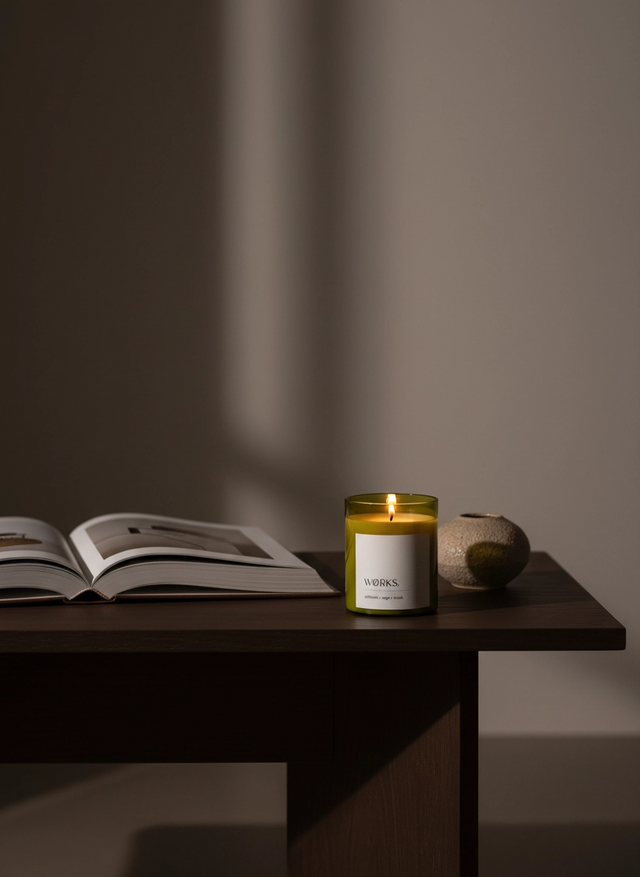
Most rooms don’t smell like anything in particular. Which is fine. Neutral is fine. But there’s a version of coming home where the air in the hallway is already doing something, where the room you walk into has a texture, a temperature, a character that wasn’t there this morning.
That version is achievable. It doesn’t require much. It requires the right two things working together.
Start with the Candle
Light the candle before you need the room. Not when guests arrive, twenty minutes before guests arrive. The wax needs time to pool evenly across the surface, and the fragrance needs time to open properly. A candle lit ten seconds before someone walks in is doing almost nothing.
WØRKS Aromatic Candles are hand-poured in Melbourne from a blend of soy and coconut wax. They burn for 70 hours each. Six fragrances, all crafted by a master perfumer in Australia, all IFRA-certified, each one designed to open slowly and last. The deep green glass vessel sits on a silicone base mat that handles heat up to 230°C and protects whatever surface it’s on.
The first half-hour of burn time is the most honest read of a fragrance. Pay attention to how the room actually smells, not what the cold throw suggested when you first opened it. Some scents, Amber in particular, become something else entirely when warm.
Layer with the Mist
The Interior Mist is a different instrument. Where the candle builds warmth slowly, the mist is immediate: three to four pumps across the cushions, once across a soft curtain, once in the air near the centre of the room. The slow-diffusion pump releases an ultra-fine mist that doesn’t leave marks or damp patches. It’s safe on linen.
WØRKS Interior Mists come in three scents: Lysår, Fjærn, and Ånde, all designed specifically for space rather than skin, all IFRA-certified. They’re a separate scent system to the candle range, so don’t go looking for a matching pair. Choose the mist for what it does to the air, then use it alongside whichever candle is already burning.
Used well, the mist fills in the top notes that a candle’s warmth alone can’t reach. The room gets depth.
Building the Layer
Complementary pairings are where this gets interesting: an Amber candle (warm, resinous, heavy base) with the Fjærn mist (cool, mineral, faintly green) creates something that doesn’t exist in either bottle alone. There’s no formula for it. Light the candle, spend some time with the room, then decide what the air needs.
Where fragrance matching does make sense is between the candle and your hand or body soap: the six candle scents mirror the personal care range exactly, so the basin and the room can run the same scent at once. The mist works on a different register entirely, chosen for the space, not matched to what else is in it.
The Rest of the House
Scent follows traffic. The bathroom and the entrance are the highest-traffic surfaces in most homes, which is why a hand soap in the right fragrance carries further than you’d think. If the soap fragrance matches the candle in the living room, the house has a thread running through it, something consistent that isn’t immediately nameable but makes the space feel considered.
The Saltbush body soap in the bathroom, the Saltbush candle in the bedroom. Vetiver at the basin, Vetiver in the study. The same fragrance in two formats, doing two jobs, without repeating themselves.
IFRA-certified fragrances. Safe on linen. 70-hour burn time.
Best deployed twenty minutes early.
0 Comments
There are no comments for this article. Be the first one to leave a message!